 |
| Robert Bunsen's 200th Birthday |
Life and work :
Bunsen was born in G?ttingen, Germany, as the youngest of four sons of the University of G?ttingen's chief librarian and professor of modern philology, Christian Bunsen (1770-1837). When attending faculty in Holzminden, in 1828 Bunsen matriculated at G?ttingen and studied chemistry with Friedrich Stromeyer, obtaining the Ph.D. degree in 1831. In 1832 and 1833 he traveled in Germany, France, and Austria, where he met Friedrich Runge (who discovered aniline and in 1819 isolated caffeine), Justus von Liebig in Gie?en, and Eilhard Mitscherlich in Bonn.
University teacher :
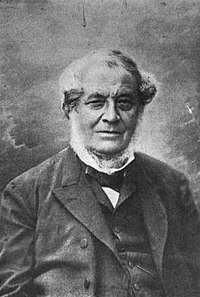 |
| Robert Wilhelm Eberhard Bunsen |
In late 1852 Bunsen became the successor of Leopold Gmelin at the University of Heidelberg. There he used electrolysis to produce pure metals, like chromium, magnesium, aluminium, manganese, sodium, barium, calcium and lithium. A protracted collaboration with Henry Enfield Roscoe began in 1852, in which they studied the photochemical formation of hydrogen chloride from hydrogen and chlorine.
Bunsen discontinued his work with Roscoe in 1859 and joined Gustav Kirchhoff to review emission spectra of heated components, a analysis area known as spectrum analysis. For this work, Bunsen and his laboratory assistant, Peter Desaga, had perfected a special gas burner by 1855, influenced by earlier models. The newer style of Bunsen and Desaga, which provided a very hot and clean flame, is now known as simply the "Bunsen burner".
There had been earlier studies of the characteristic colours of heated parts, but nothing systematic. Within the summer of 1859, Kirchhoff instructed to Bunsen that he strive to form prismatic spectra of those colors. By October of that year the 2 scientists had invented an applicable instrument, a prototype spectroscope. Using it, they were in a position to identify the characteristic spectra of sodium, lithium, and potassium. Once varied laborious purifications, Bunsen proved that highly pure samples gave unique spectra. In the course of this work, Bunsen detected previously unknown new blue spectral emission lines in samples of mineral water from Duerkheim, Germany. He guessed that these lines indicated the existence of an undiscovered chemical element. Once careful distillation of forty tons of this water, within the spring of 1860 he was able to isolate seventeen grams of a brand new element. He named the element "caesium", once the Latin word for deep blue. The following year he discovered rubidium, by an analogous process.
In 1860, he was elected an overseas member of the Royal Swedish Academy of Sciences.
Temperament :
Bunsen was one of the most universally admired scientists of his generation. He was a master teacher, devoted to his students, and that they were equally dedicated to him. At a time of vigorous and often caustic scientific debates, Bunsen continually conducted himself as a good gentleman, maintaining his distance from theoretical disputes. He abundant most popular to figure quietly in his laboratory, often enriching his science with helpful discoveries. On a point of principle, he never took out a patent, despite the fact that his new battery and new laboratory burner would surely have brought him nice wealth. Bunsen never married.
Retirement and death :
When Bunsen retired at the age of seventy eight, he shifted his work solely to geology and mineralogy, an interest that he had pursued throughout his career. He died in Heidelberg aged 88.
Jetsada has been writing articles online for nearly 2 years now. Not only does this author specialize in Robert Wilhelm Bunsen, you can also check out his latest website about:
http://www.onlinebestshoppingstore.com Which reviews and lists the best
Big Online Shopping

No comments:
Post a Comment